

What Is the Bahrain GCC Resident Visa?
The Bahrain GCC Resident Visa is a special entry permit designed for individuals who hold valid residency in any Gulf Cooperation Council (GCC) country. If you live and work in Saudi Arabia, the United Arab Emirates, Kuwait, Oman, or Qatar, you may qualify for simplified entry into Bahrain through this dedicated visa channel.
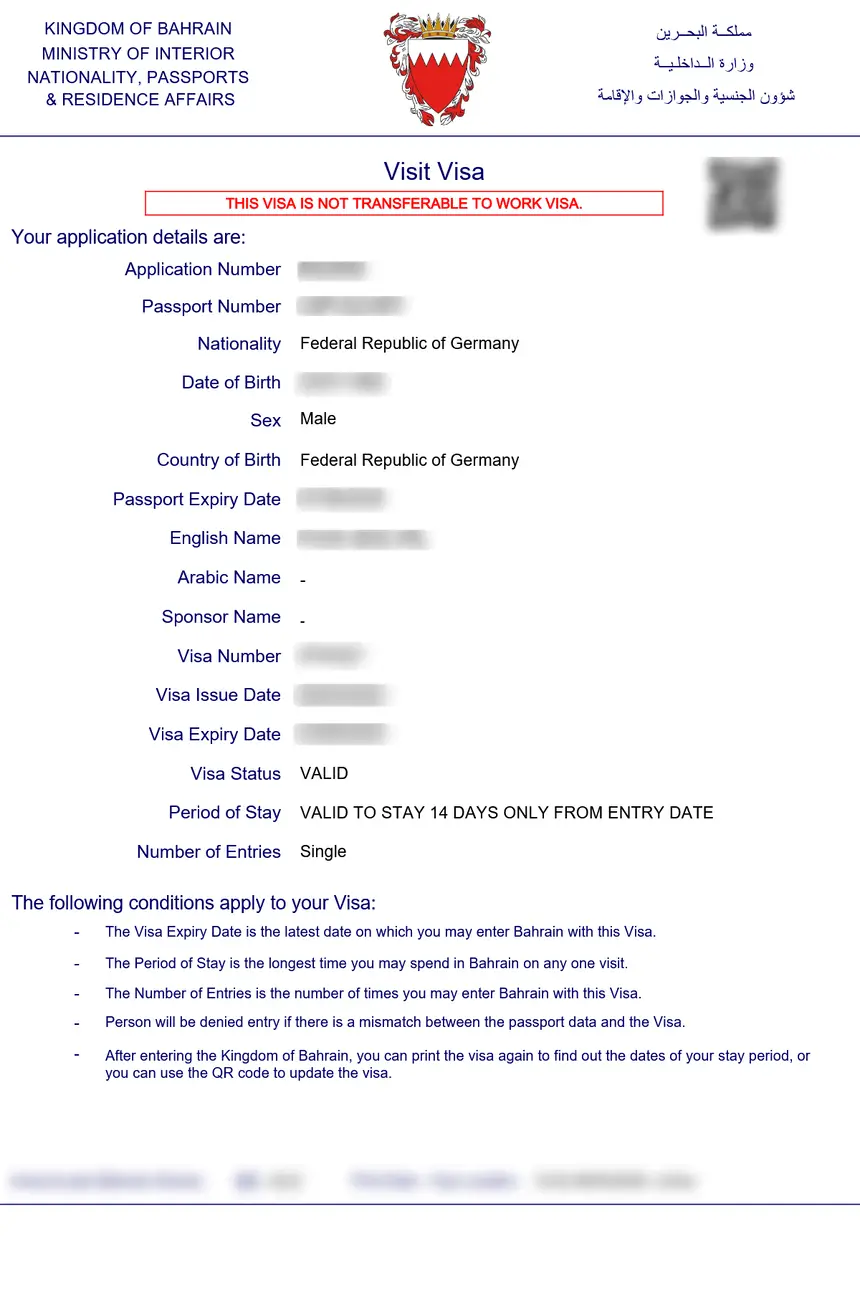
Unlike standard tourist or business e-Visas, the GCC Resident Visa recognizes your established legal status in the region. Bahrain’s Nationality, Passports and Residence Affairs (NPRA) department administers this visa category, acknowledging that residents of neighboring Gulf states are already vetted and trusted by regional immigration authorities.
This visa category exists because the six GCC nations – Bahrain, Kuwait, Oman, Qatar, Saudi Arabia, and the UAE – maintain close economic and social ties. Workers, professionals, and families frequently move between these countries for business meetings, medical treatment, shopping, tourism, and family visits. The GCC Resident Visa streamlines this cross-border movement.
How the GCC Resident Visa Differs from a Standard e-Visa
The key distinction is that eligibility depends on your residency status in a GCC country, not your nationality. An Indian national working in Dubai or a Filipino engineer based in Riyadh can access this visa category, even though their passport alone might not qualify them for visa-free entry.
Processing is generally faster, documentation requirements are lighter, and the visa is tailored to the needs of regional residents who travel between Gulf states regularly. However, the specific advantages depend on which GCC country you hold residency in and what profession you practice.
Who Qualifies as a GCC Resident?
To qualify for the Bahrain GCC Resident Visa, you must hold a valid residence permit (also called an iqama or residence visa) issued by one of the five GCC countries other than Bahrain. Your residence permit must be current and not expired.
Eligible GCC Residency Countries
The five qualifying countries are:
- Saudi Arabia – Holders of a valid Saudi iqama (residence permit)
- United Arab Emirates – Holders of a valid UAE residence visa
- Kuwait – Holders of a valid Kuwait residence permit
- Qatar – Holders of a valid Qatar residence permit (QID)
- Oman – Holders of a valid Oman residence visa
Your GCC residence permit must typically have at least three to six months of remaining validity at the time of your Bahrain entry. Requirements can vary, so checking the latest rules on evisa.gov.bh before traveling is recommended.
Profession-Based Eligibility
Bahrain applies profession-based criteria for some GCC Resident Visa categories. Certain professional classifications receive preferential treatment:
- Doctors, dentists, and medical professionals
- Engineers (civil, mechanical, electrical, and other disciplines)
- Lawyers and legal consultants
- Business owners and company directors
- University professors and academic researchers
- Senior management and executive-level employees
- Government employees and diplomats
If your residence permit lists one of these professions, you may qualify for expedited processing, longer validity periods, or multiple-entry privileges. Workers in other categories can still apply but may receive different visa terms.
GCC Nationals vs. GCC Residents: Understanding the Difference
It is important to distinguish between GCC nationals (citizens) and GCC residents (expatriates living in GCC countries). These two groups have very different entry rules for Bahrain.
GCC Nationals: Visa-Free Entry
Citizens of all six GCC countries – Bahrain, Kuwait, Oman, Qatar, Saudi Arabia, and the UAE – can enter Bahrain without any visa. They simply present their national ID card or passport at the border. No application, no fees, no processing time. This right stems from the GCC’s founding agreement and reflects the deep integration between member states.
GCC nationals can stay in Bahrain for extended periods and enjoy full freedom of movement similar to citizens of the European Union traveling within the Schengen zone. They can work, live, and conduct business in Bahrain with minimal restrictions.
GCC Residents: Visa Required (But Streamlined)
If you are not a GCC national but hold residency in a GCC country, you still need a visa to enter Bahrain. However, your GCC residency status gives you access to streamlined visa channels that are not available to applicants applying purely on the basis of their home-country nationality.
The GCC Resident Visa acknowledges that you have already undergone background checks, employment verification, and immigration screening in your country of residence. This pre-existing vetting makes the Bahrain application process faster and simpler.
Application Process for GCC Residents
Applying for the Bahrain GCC Resident Visa follows a similar path to the standard e-Visa but with some important differences in required documentation.
Step 1: Check Your Eligibility on evisa.gov.bh
Visit the official NPRA portal at evisa.gov.bh and navigate to the visa application section. Select the option that corresponds to GCC residents. The system will ask for your nationality and current country of residence. If you select a GCC country as your residence, the portal will display the applicable visa options.
Step 2: Prepare Your Documents
GCC residents need to provide:
- Valid passport with at least six months of remaining validity from your planned arrival date
- GCC residence permit (iqama/QID) – a clear, color scan of both sides showing your name, profession, photo, and expiry date
- Passport-sized photograph taken within the last six months against a white background
- Proof of accommodation in Bahrain (hotel booking or invitation letter from a host)
- Return or onward travel ticket showing your departure from Bahrain
The GCC residence permit is the critical document that distinguishes your application from a standard e-Visa submission. Ensure the scan is high quality and all text is legible.
Step 3: Submit the Application Online
Complete the online form with your personal details, travel information, and purpose of visit. Upload your documents and pay the processing fee via credit or debit card.
Step 4: Receive Your Visa
Processing typically takes 1-3 business days for GCC residents, which is faster than the standard 3-5 business day processing time. Once approved, you receive a confirmation email with your e-Visa details. The visa is electronically linked to your passport.
Bahrain GCC Resident Visa Fees
Fees for the GCC Resident Visa are generally comparable to standard e-Visa fees, though specific costs depend on the visa type and duration selected.
| Visa Type | Approximate Fee (BHD) | Approximate Fee (USD) |
|---|---|---|
| Single-entry (14 days) | 5-9 | 13-24 |
| Single-entry (30 days) | 9-15 | 24-40 |
| Multiple-entry (3 months) | 20-30 | 53-80 |
| Multiple-entry (1 year) | 40-60 | 106-160 |
These are approximate ranges. The exact fee is displayed during the application process on evisa.gov.bh. Payment is made online via credit or debit card, and the fee is non-refundable regardless of the application outcome.
Some professional categories may qualify for reduced fees or extended validity at no additional cost. This varies and is determined by NPRA based on your profession as listed on your GCC residence permit.
Country-Specific Rules for GCC Residents
Each GCC country has slightly different arrangements with Bahrain that can affect the visa process for their residents.
Saudi Arabia (Iqama Holders)
Saudi residents represent the largest group of GCC Resident Visa applicants due to the King Fahd Causeway connecting the two countries. Key points:
- Land border crossing: Saudi residents can enter Bahrain via the King Fahd Causeway using a valid Saudi iqama and passport. A separate e-Visa can be obtained at the causeway immigration office.
- Validity requirement: Your Saudi iqama must have at least three months of remaining validity.
- Profession matters: Saudi iqamas listing professional occupations receive more favorable visa terms than labor-category iqamas.
- Multiple-entry options: Frequent travelers from Saudi Arabia can obtain 3-month or 1-year multiple-entry visas.
United Emirates (UAE Visa Holders)
UAE residents benefit from strong bilateral ties between the two countries:
- Flight frequency: Multiple daily flights between Dubai, Abu Dhabi, and Manama make travel convenient.
- Processing speed: UAE residents often report faster processing times (sometimes within 24 hours).
- Business visa access: UAE-based business professionals can easily obtain business e-Visas with company invitation letters.
Kuwait
Kuwait residents have several advantages:
- Geographic proximity: Kuwait is relatively close to Bahrain, with direct flights taking approximately 1.5 hours.
- Established expat community: A large Kuwait-based expat community regularly visits Bahrain for weekends and holidays.
- Family visit provisions: Kuwait residents with family in Bahrain can apply for family visit e-Visas with simplified documentation.
Qatar
Qatar-Bahrain relations have evolved significantly, affecting visa access:
- Direct flights available: Regular flights connect Doha and Manama.
- Residency verification: QID (Qatar ID) holders must ensure their Qatar residence is active and valid.
- Business travel: Qatar-based professionals visiting Bahrain for business meetings can use the business e-Visa category.
Oman
Oman residents can access Bahrain through:
- Air travel: Direct flights between Muscat and Manama.
- Residence visa validity: Oman residence visas must have at least six months of remaining validity for the most favorable visa terms.
- Professional categories: Similar to other GCC countries, professional occupation holders receive preferential treatment.
Required Documents Checklist
Here is a complete checklist of documents you need when applying for the Bahrain GCC Resident Visa:
- Valid passport – Minimum six months validity from arrival date, clear color scan of bio-data page
- GCC residence permit – Current and valid, clear scan showing both sides, must display your profession
- Passport photo – Recent (within 6 months), white background, full face, color
- Hotel booking or invitation letter – Confirmed accommodation for your stay
- Return ticket – Flight or transport booking showing departure from Bahrain
- Proof of profession – May be required for profession-based categories (employment letter, professional license)
- Bank statement or salary certificate – Not always required but recommended to demonstrate financial means
Common Document Mistakes to Avoid
- Submitting an expired GCC residence permit scan
- Providing a blurry or low-resolution image of your iqama or QID
- Name mismatch between passport and GCC residence permit
- Passport expiring within six months of travel date
- Hotel booking dates not covering the full stay duration
Processing Times and Validity Periods
GCC residents generally enjoy faster processing than standard applicants:
| Processing Category | Standard e-Visa | GCC Resident |
|---|---|---|
| Typical processing time | 3-5 business days | 1-3 business days |
| Fastest reported time | 24-48 hours | Same day |
| Recommended application lead time | 2 weeks | 1 week |
Validity periods for GCC Resident Visas match standard e-Visa categories:
- 14-day single-entry: Valid for 30 days from approval, one entry, up to 14 days stay
- 30-day single-entry: Valid for 30 days from approval, one entry, up to 30 days stay
- 3-month multiple-entry: Valid for 90 days, multiple entries, up to 30 days per stay
- 1-year multiple-entry: Valid for 365 days, multiple entries, up to 30 days per stay
Extending Your Stay in Bahrain
If you need to remain in Bahrain beyond your visa’s allowed duration, you can apply for an extension through the government services portal at services.bahrain.bh. The extension must be filed before your current visa expires.
Key extension rules:
- Extensions are subject to NPRA approval
- Overstaying without an approved extension results in fines
- Multiple extensions may be possible but are limited by NPRA discretion
- Extension fees vary by visa type and duration requested
- GCC residents with strong professional credentials may receive more favorable extension terms
King Fahd Causeway: Special Entry for Saudi Residents
The King Fahd Causeway is a 25-kilometer bridge connecting Saudi Arabia’s Eastern Province to Bahrain. It is the busiest land border crossing in the GCC, with millions of vehicles crossing annually.
Causeway-Specific Visa Options
Saudi residents can obtain a Bahrain visa at the causeway immigration office, though applying online through evisa.gov.bh in advance is recommended to avoid delays. During peak periods such as weekends, public holidays, and the Formula 1 Grand Prix, causeway wait times can exceed several hours.
Tips for Causeway Crossings
- Apply for your e-Visa online before traveling to avoid causeway queues
- Carry printed copies of your visa confirmation as backup
- Check causeway traffic conditions before departing (apps and websites provide real-time updates)
- Ensure your vehicle insurance covers Bahrain if driving across
- Carry your passport and original GCC residence permit (not just copies)
- During peak times, consider traveling early morning or late evening
Common Questions About the GCC Resident Visa
Can I enter Bahrain with just my GCC residence permit?
No. Unless you are a GCC national (citizen), you need both your passport and a valid visa. The GCC residence permit alone is not sufficient for entry, but it qualifies you for the streamlined GCC Resident Visa category.
Does my GCC residence permit need to be in English?
Bahrain immigration accepts Arabic and English documents. If your residence permit is in another language, you may need a certified translation. Most modern GCC residence permits include English text alongside Arabic.
Can my family apply for the same visa category?
Your spouse and dependents who also hold valid GCC residence permits can apply under the same category. Children under 18 typically apply through their parent’s application. Family members who do not hold GCC residency must apply under standard visa categories.
What if my GCC residence permit expires while I am in Bahrain?
Your Bahrain visa validity is tied to your GCC residence permit. If your residence permit expires while you are in Bahrain, your visa status may be affected. It is recommended to ensure your GCC residence permit has sufficient validity before traveling.
Can I work in Bahrain with a GCC Resident Visa?
No. The GCC Resident Visa is for short-term visits only – tourism, business meetings, family visits, medical treatment, and similar purposes. To work in Bahrain, you need a separate work visa and residency permit sponsored by a Bahraini employer.
Is there a difference between the GCC Resident Visa and a regular e-Visa?
Functionally, they grant the same entry rights. The difference is in eligibility criteria and potentially faster processing. The GCC Resident Visa leverages your existing vetting in another GCC country as a basis for expedited approval.
Do I need to show a return ticket?
Yes. A confirmed return or onward travel ticket is required to demonstrate that you intend to leave Bahrain before your visa expires. This applies to all e-Visa categories, including the GCC Resident Visa.
Can I apply for a Bahrain GCC Resident Visa upon arrival?
While some visa-on-arrival options exist at Bahrain International Airport and the King Fahd Causeway, applying through evisa.gov.bh before travel is strongly recommended. Pre-approval eliminates the risk of denial at the border and speeds up your entry process.
Tips for a Successful Application
Follow these guidelines to maximize your chances of approval:
- Apply early: Submit your application at least one week before travel, even though processing is typically faster for GCC residents
- Double-check documents: Ensure all scans are clear, legible, and in the correct format (JPG, PNG, or PDF)
- Match your names: Your name must appear identically on your passport and GCC residence permit. Even small spelling differences can cause delays
- Keep your residence permit current: An expiring iqama or QID is the most common reason GCC residents face visa complications
- Use the official portal: Always apply through evisa.gov.bh rather than third-party services to avoid fraud and unnecessary fees
- Save your reference number: After submitting, immediately save your application reference number for tracking